Private overview

By invitation.

A walkthrough of MGC CRM — the operating system a commercial brokerage wrote for its own book, now opened to a few others. Enter the access code to continue.
Incorrect code — try again.
Muljat Group Commercial · Bellingham, WA
MGC CRM — OVERVIEW
Built by brokers, inside a working brokerage
The private operating system for commercial real estate.
Sales and leasing on one board, with a lease lifecycle for every suite rather than every building. Written inside a commercial brokerage in Bellingham, Washington, and now opened to a few others.
ForBrokerage principals FromTroy Muljat · Muljat Group Commercial List$175 / licensed broker / mo
Before anything else

We are a brokerage.
We are not a software company.

Muljat Group Commercial sells and leases commercial property in Bellingham, Washington. We wrote this because our own shop needed it — not because we set out to be in the software business. Every screen in this deck is our real book, running today.

630
Suites tracked across 98 buildings, 1.19 million square feet
15,000+
Live listings across WA, ID and OR, reloaded weekly
3
Pipelines on one board — sales, leasing and leads
Every figure here is computed from the deals underneath — not typed into a slide.
Why we stopped buying software

A general CRM with
an industry skin.

We ran the same stack you do. A pipeline CRM that didn't know what a suite was. A separate offering-memorandum product. A separate listing microsite. A comps database somebody maintained by hand. Four line items, four logins, and a platform fee on top of all of it.

What we were paying for

Four products

  • The pipeline — built for widgets, skinned for real estate
  • The offering memorandum — a separate line item
  • The listing microsite — another one
  • The comps database — maintained by a person, by hand
  • The platform fee — the most-hated line in this category
What Monday actually needed

One record

  • A building that is eight suites, each on its own clock
  • A listing that has to be posted in seven places today
  • A landlord asking what the traffic did last quarter
  • A renewal notice window that cannot be missed
  • An owner who wants an answer before you hang up
So we wrote it

It fits like it was built
in‑house, because it was.

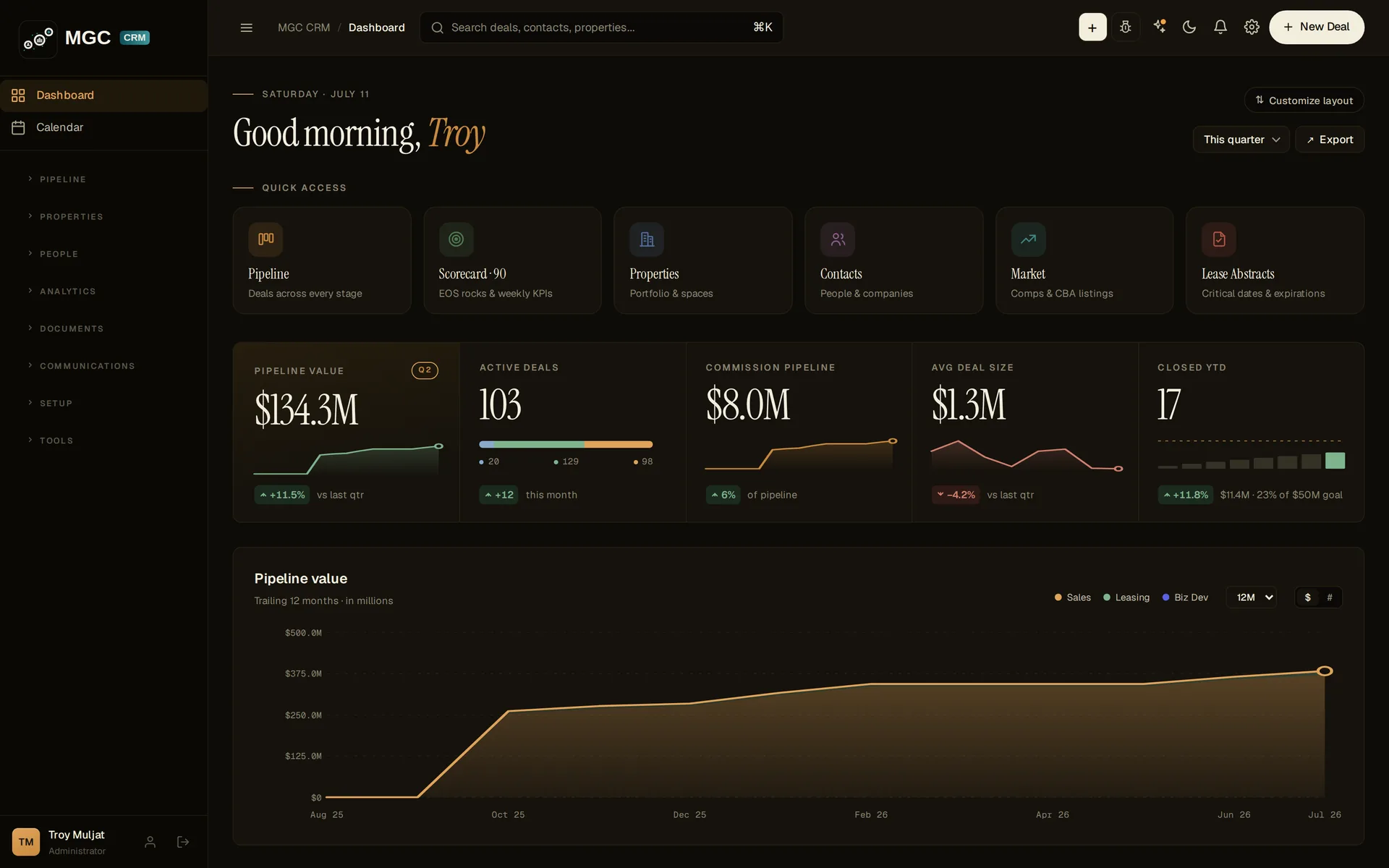
The MGC CRM dashboard — pipeline value, active deals and a twelve-month trend
1
System — pipeline, OM, listing site and comps in one record
0
Platform fee. Admins and assistants do not take a seat
Live
In production in the brokerage that wrote it — this is the real dashboard
It knows what a suite is, what a stacking plan is, and where a listing has to be posted the day it goes live — because it had to.
The three things nobody else sells

Recognised in the demo.
Hard to copy.

01

Syndication that flips

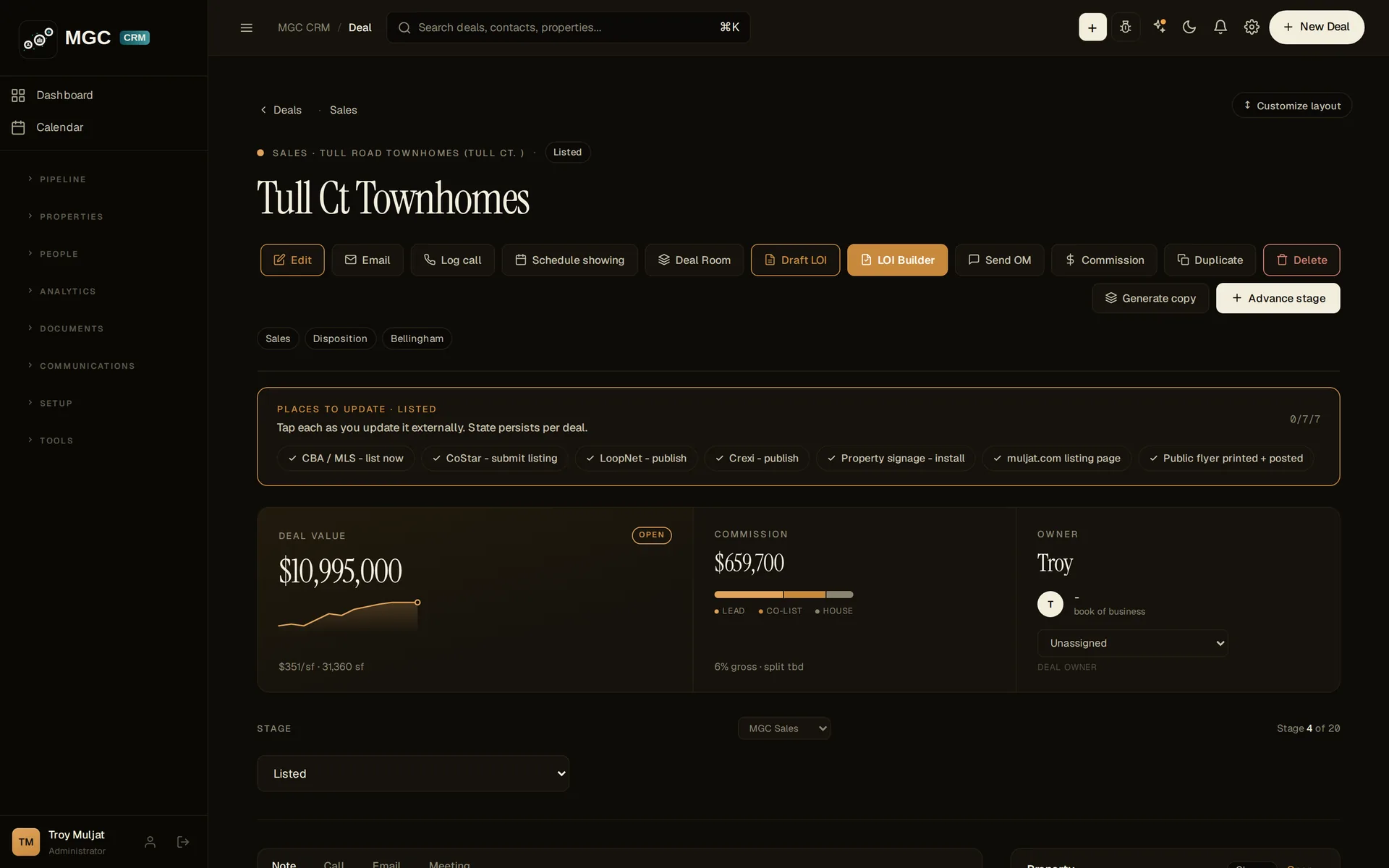
Hit Listed and the deal page prints where it has to go. Close or withdraw and the same list becomes the take‑down.

Ticked off on the record, not in someone's head
02

Traffic you keep

CBA, CoStar and Crexi keep a rolling 7 / 30 / 90 day window. We archive the monthly figures permanently.

What a landlord actually wants at renewal
03

A suite, not a building

Eight lease stages per suite, with a scaled stacking plan, WALT and rent roll computed underneath.

General CRMs treat this as a field. Here it is the spine
These are the three a broker recognises inside five minutes of a walkthrough — and the three a general CRM cannot bolt on.
The spine

A building is
not one deal.

Every suite runs its own eight‑stage lifecycle — Analyze through Listed, Lease Signing, Collect. Bind a deal to a suite and the two stay in step. Six hundred and thirty suites are tracked this way in the brokerage that built it.

Stacking planFloor by floor, block width to scale, coloured by expiry year. You see rollover instead of reading about it.
ComputedOccupancy, vacant SF, WALT and average in‑place rent are calculated from the suites — nobody maintains a second spreadsheet.
Critical datesLease expirations and option notice windows come off the suite record and land on the calendar before they slip.
Rent rollThe rent roll is a view of the suites, not a document somebody rebuilds every quarter.
This is the part that is structurally hard to copy — it is the data model, not a feature.

The one nobody writes down

Where this listing
needs to go.

When a deal changes stage, the deal page tells you what the outside world still needs to be told. Not a static checklist — one that changes with the stage.

Hit ListedThe page prints the list: CBA and the MLS, CoStar, LoopNet, Crexi, the sign, the website, the flyer.
In flightEach one is ticked off on the deal — so the next person can see what is still out there.
Close or withdrawThe same list flips to the take-down version. Nothing sits live on Crexi three months after it leased.
MarketingThe public offering memorandum and its QR code start from the same page — not a separate product.
Every shop already does this. Almost nobody does it on the record.
The renewal conversation

The portals forget.
You shouldn't.

What the portals give you

A rolling window

  • CBA, CoStar and Crexi show the last 7, 30 or 90 days
  • Last quarter's numbers are simply gone
  • Nothing to hand a landlord who asks what the year did
  • Screenshots in a folder, if somebody remembered
What this keeps

A permanent series

  • Monthly figures archived on the listing, forever
  • The full history when the lease comes up for renewal
  • Evidence for a price conversation, not an opinion
  • Owned by you — it survives switching portals
Small feature. It is the one landlords notice.
Where the week starts

Three pipelines.
One board.

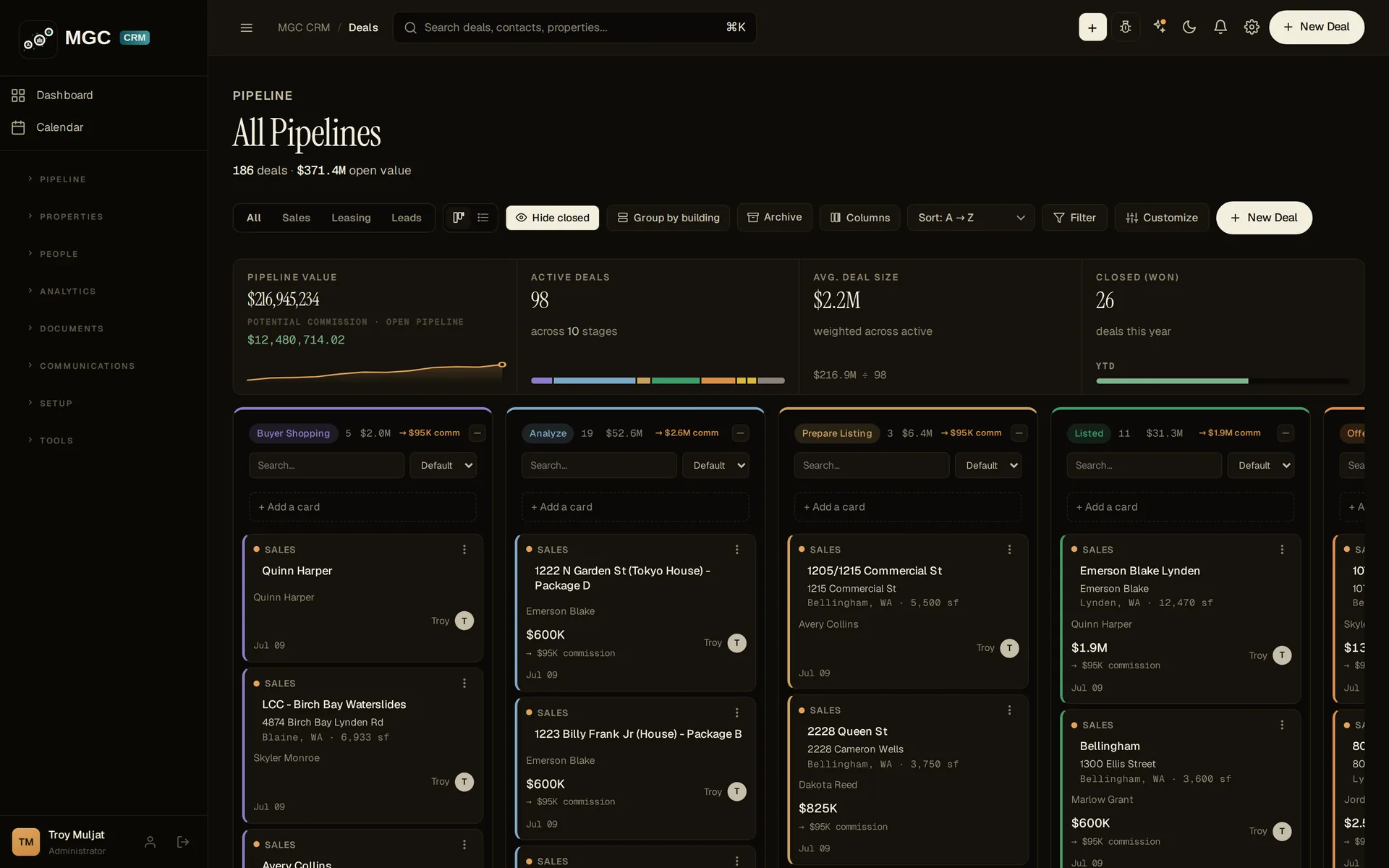
The MGC CRM pipeline board — sales, leasing and leads
3
Sales, leasing and leads — each with its own stages and its own rules
1
Record the whole shop reads — group by building or filter to one pipeline
Removed deals go to an archive and restore in one click
Offers tracked on the card from received through accepted. Closed and lost stages ask for the fields that matter — and nothing else.
Every property, with receipts

Facts the county
already published.

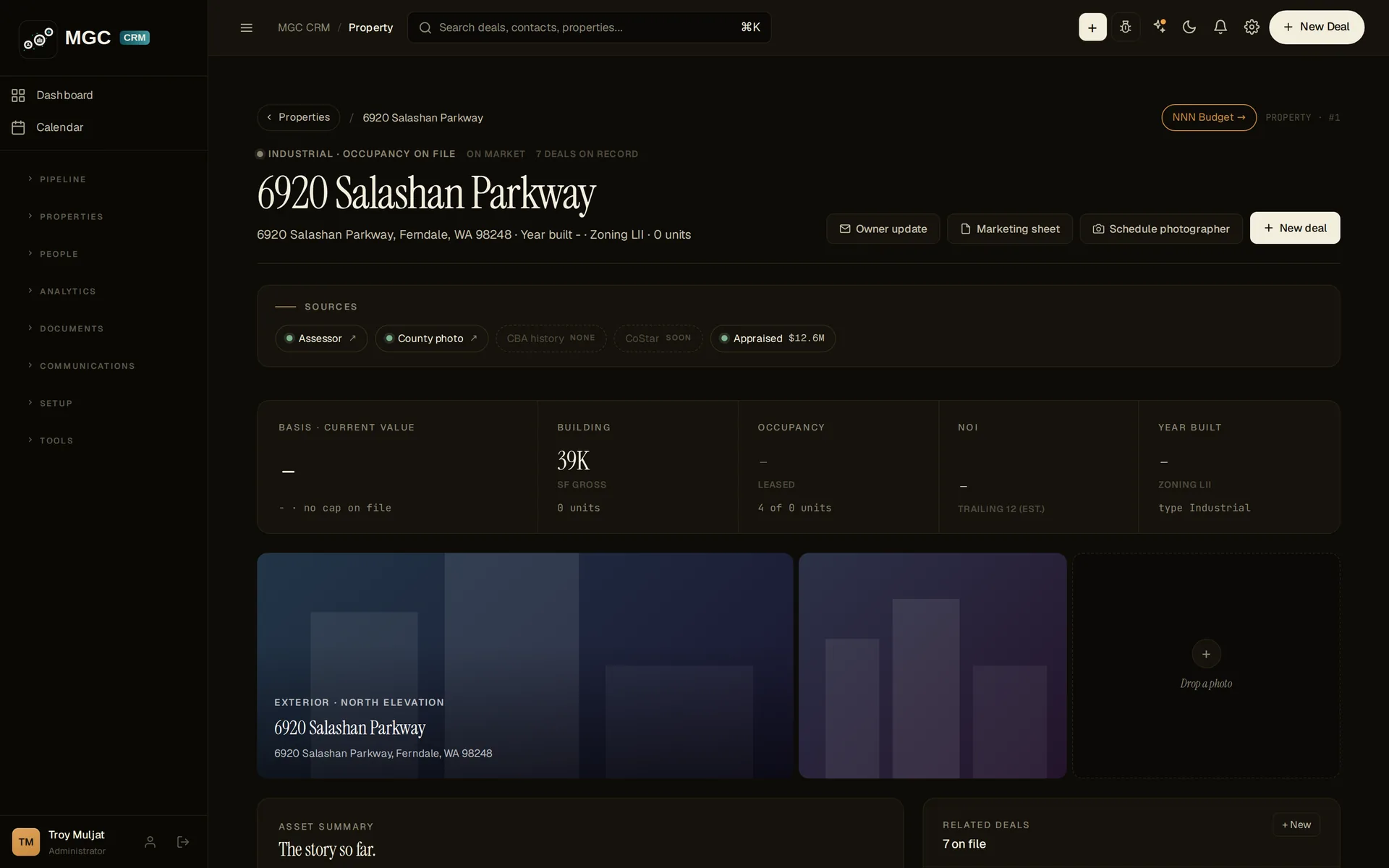
The MGC CRM property record
Regrid
Nationwide parcel, owner and coordinates — pulled, not keyed
12,500+
Washington listings from the CommercialMLS feed, reloaded weekly
Keys
Lockbox, gate and alarm codes indexed across the whole portfolio
Nobody keys the parcel number in, so nobody keys it in wrong — and closed-won deals become sale and lease comps automatically, out of your own book.
The line items you stop buying

The offering memorandum
ships from the deal.

A public offering memorandum generated from the deal record
OM
Public offering memorandum built off the record — not a separate subscription
QR
Code on the sign and the flyer points at the live page
Deal room
Click‑accept confidentiality agreement with a signer log
One source of truth. Change the deal and the marketing changes with it.
Scoped to your book, not to the internet

When the data isn't there,
it says so.

Ask about the pipeline and the answer is computed from live rows. It is sandboxed to your CRM and to commercial real estate. It does not invent a number to fill a sentence.

MODEL

Grok or Claude

Switched from the panel. Your organisation's own keys, under Integrations.

MEETINGS

Notes in, tasks out

Paste the notes from the tour. The assigned tasks come back out and land on the calendar.

LEASES

Abstracted

Lease PDFs read into tenant, rent, term, options and critical dates.

VOICE

On the drive back

Voice entry for a new deal before you've pulled out of the parking lot.

Email intake reads the CC'd inbox and files it against the matching open deal — and asks a human when it isn't sure.
One calendar for the whole shop

Typed once.
Everywhere it belongs.

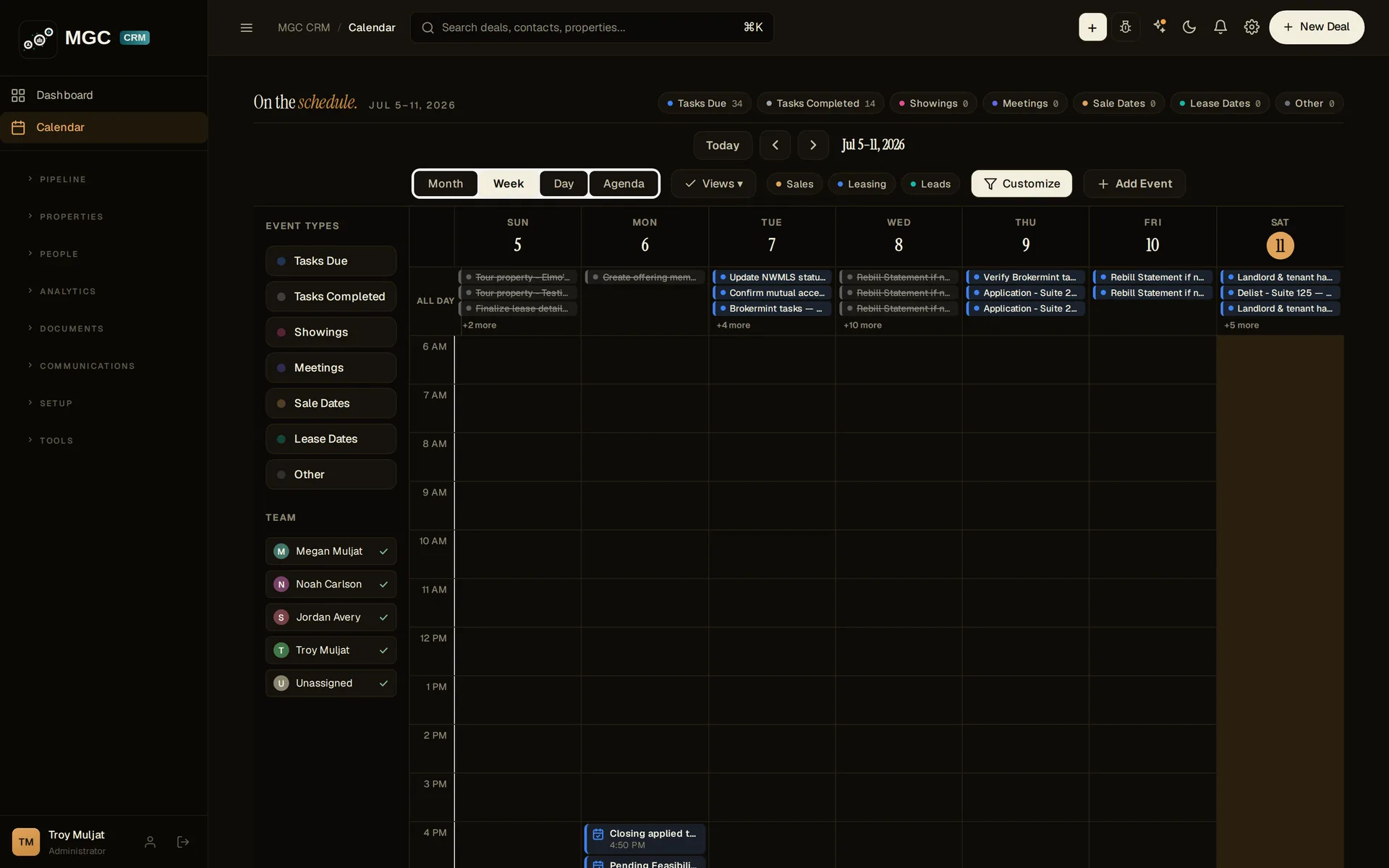
Tasks, showings, meetings and critical dates on one grid
1
Grid — tasks, showings, meetings, sale dates and lease dates, filtered per teammate
Auto
Action plan templates fire a checklist when a deal changes stage
11
EOS scorecard KPIs pulled from the pipeline and frozen weekly
The work an action plan created shows up here without anyone typing it twice.
A log you cannot edit

Rewriting history
breaks the chain.

Database triggers write every change to an append‑only log with a SHA‑256 hash chain. Not a settings toggle, not an admin feature — it happens underneath the application, where nobody can turn it off.

Append-only
Written by database triggers, not by the app
SHA‑256
Hash chain — an altered row breaks every link after it
Every
Connection listed on the integrations page with its live row count, including the ones switched off
The same discipline runs through the product: it tells you what is connected and what isn't.
Before you ask

Things we will not claim.

There is a version of this deck with a row of customer logos on it. We don't have those yet — so here is the other half of the truth instead.

One brokerage runs this in production today: the one that built it. You would be early. We would rather you know now than find out later.

No CoStar integration. Market data comes from the CBA feed. A CoStar export still has to be loaded by hand.

No commission split ledger. There is a calculator with a co‑broke toggle and a leaderboard. Splits are not accounted for automatically.

No e‑signature. The deal room is a click‑accept confidentiality agreement with a signer log, which is not the same thing.

Parcel lookup is nationwide via Regrid — an admin pastes the token. Coverage is only as good as Regrid is in that county.

Split ledger and e‑signature are on the list. We would rather say so on this slide than in month two.

Pricing · the list is public

One licensed‑broker price.
Admins are free.

Shop · 1–3 licensed brokers
$1,750
per licensed broker / year
$146 / mo effective
  • Or $175 / mo, from six brokers up
  • White‑glove migration included
  • Admins and assistants are free
Volume · 4–15 licensed brokers
$1,500
per licensed broker / year
$125 / mo effective
  • The break after three
  • $2,500 onboarding, credited in full at ten
  • Admins and assistants stay free
Firm · 16–50 licensed brokers
$1,300
per licensed broker / year
$108 / mo effective
  • Migration and onboarding included
  • Stages, fields and action plans configured with you
  • Quarterly roadmap call
$0
Platform fee — the most‑hated line in this category
$0
Per admin or assistant. They do not count as a broker
10%
Of the gross commission on one $5M sale, for a ten‑broker firm, for the year
How access works

Introduction, walkthrough,
live.

We open MGC CRM one brokerage at a time. There is no card form and nothing to sit through before you see the live system.

i · Two minutes

Introduce your brokerage

Tell us about your team and your market. A person reads it and replies personally.

ii · A working session

A private walkthrough

Not a webinar. Inside the live system, on the workflows your team actually runs.

iii · Before you switch

Migrated, then live

Your pipelines, properties and people come across first. White glove, not white paper.

A direct line to the people who write the code, and a real voice in what gets built next. The first few outside firms get a founding rate — timeboxed, and written down.
The short version
Built inside
a working brokerage.

We had to use it on Monday, so it knows what a suite is. It replaces a stack instead of skinning a CRM. And when it can't do something, this is the deck that told you so first.

Troy Muljat  ·  Muljat Group Commercial Bellingham, Washington mgcre.com — request access
01 / 18
← / → to navigate